

What happens when we challenge the way things have always been done?
At WEFTEC 2026, innovation and curiosity took center stage as catalysts for solving some of the world’s toughest water challenges. For me, the message resonated deeply, both personally and professionally.
I attended as a participant in the Water Environment Federation’s Water Leadership Institute (WLI), an experience that broadened my leadership perspective and brought me together with water professionals from across the industry. Through collaboration and our work on the Circular Water Economy, I was reminded of something fundamental: Progress starts with the willingness to ask different questions.
It’s also the very foundation on which BlueConduit was built.
Innovation begins with curiosity
The water industry is navigating significant change. Aging infrastructure, evolving regulations, workforce challenges, and increasing demands on resources require us to rethink how we operate and plan for the future.
Innovation isn’t simply about adopting the newest technology. It’s about challenging assumptions, exploring alternatives, and finding better ways to solve longstanding problems.
BlueConduit was born out of that very mindset.
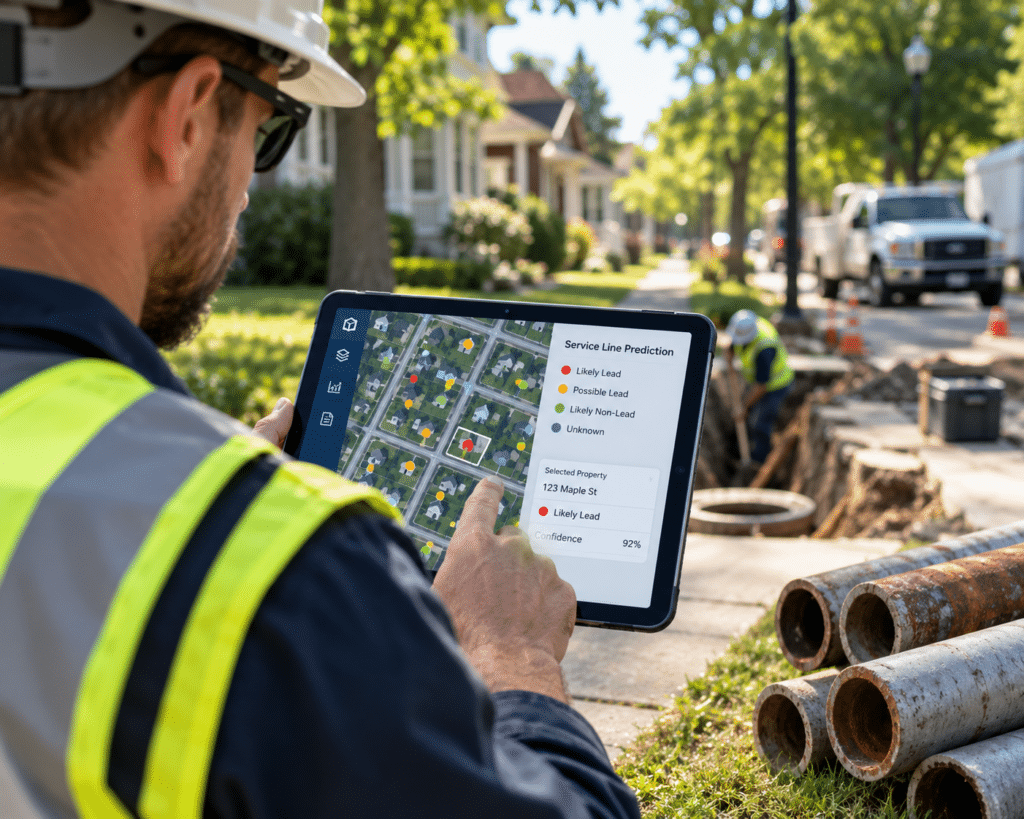
Our story began in Flint, Michigan, where two University of Michigan professors, Eric Schwartz and Jake Abernethy, came together with a shared belief that data science could help solve a critical public health challenge. As Flint confronted the devastating consequences of its water crisis, they began asking different questions. Could artificial intelligence and machine learning help identify where lead pipes were buried? Could technology help utilities make better decisions with incomplete information?
Those questions ultimately led to the creation of BlueConduit.
What began as an innovative approach to one community’s challenge has grown into work supporting hundreds of utilities and communities across the country.
We were born out of curiosity. Out of questioning traditional approaches. Out of recognizing that longstanding infrastructure challenges required new ways of thinking and better solutions.
And when I think about how far we’ve come, that evolution is especially meaningful.
When BlueConduit first began applying machine learning to identify lead service lines in Flint, we were among the early pioneers challenging traditional approaches to infrastructure assessment. Long before AI became a mainstream conversation, we were putting machine learning to work on one of the water industry’s most pressing challenges. At the time, predictive modeling was far from conventional.
Fast forward to 2026, and we’re seeing just how far that thinking has come. In its August 2026 guidance under the Lead and Copper Rule Improvements (LCRI), the EPA explicitly encourages utilities to explore predictive modeling, including AI, to identify service line materials, with state approval. As we explored in a recent BlueConduit article on the EPA’s guidance, this represents an important milestone for the industry.
Think about that. What began with two professors asking whether technology could help solve a critical challenge in Flint is now an approach being encouraged at the federal level.
It’s a powerful example of what innovation can accomplish. An unconventional idea, backed by research, collaboration, and demonstrated results, can help change how an entire industry approaches a problem.
We’re not using technology simply because it’s available or because AI is the latest conversation. We’re applying it to real problems and helping utilities uncover opportunities they may not have otherwise considered.
Innovation isn’t something we adopted along the way. It’s why we exist.
Connecting innovation to impact
One of the highlights of my WEFTEC experience was sharing our WLI team’s work on the Circular Water Economy.
Our case study explored what it takes to move circular water principles beyond ideas and into measurable, actionable practices. We considered not only technical innovation but also the leadership, partnerships, and accountability required to make meaningful progress.
For me, the connection to our work at BlueConduit was clear.
Whether we’re discussing water reuse, infrastructure replacement, or predictive modeling, the challenge is similar: How do we turn information, ideas, and emerging technology into decisions that create lasting value?
In my role leading Customer Success, I see this intersection every day.
Some of the most meaningful conversations I’ve had with customers have involved challenging the way they’ve traditionally approached a problem. I’ve encouraged utility teams to explore alternatives, reconsider assumptions, and look at their data and infrastructure challenges through a different lens. Sometimes that means rethinking how they prioritize investigations. Other times, it’s exploring how predictive insights can complement existing processes or inform decisions that might otherwise rely on limited information.
Those conversations aren’t always easy. Change requires trust, openness, and a willingness to consider something unfamiliar. It also requires listening, understanding the realities our customers face, and recognizing that the right solution isn’t always the most obvious one.
To me, that’s an essential part of Customer Success. It’s not simply about implementing technology or supporting its use. It’s about being a strategic partner, asking thoughtful questions, and helping customers recognize opportunities to achieve better outcomes.
After all, innovation only matters when it translates into meaningful impact.
The opportunity ahead
What I appreciated most about WEFTEC 2026 was the reminder that innovation isn’t limited to any one technology, organization, or discipline.
My experience with WLI reinforced something equally important: the value of community. Bringing together professionals with different backgrounds, experiences, and perspectives creates opportunities to challenge one another, exchange ideas, and develop solutions that no single organization could achieve alone.
As AI and machine learning continue to evolve, the water industry has an incredible opportunity to address longstanding challenges in new ways. These technologies are transforming how we understand infrastructure, assess risk, and make decisions. But realizing their full potential will require the leadership, collaboration, and willingness to think differently that drive meaningful change.
For BlueConduit, that commitment isn’t new. It’s foundational to who we are and continues to guide our work with utilities today.
The challenges facing the water industry are too complex for any one company, technology, or individual to solve.
It’s going to take innovation. It’s going to take curiosity. It’s going to take community. And it’s going to take all of us coming together, sharing what we know, challenging what’s possible, and working collectively to solve these issues.
At BlueConduit, we’ve been committed to this work from the beginning, and that commitment continues.
So, what challenge is your utility ready to rethink, and what could we solve together?