The Walter E. Washington Convention Center is about to become the most important room in water infrastructure. AWWA’s Annual Conference and Exposition, June 21 through 24 in Washington D.C., is where the people actually doing this work come together. Engineers, utility directors, capital planners, regulators. All in one place, asking the same question they always come back to: are we doing this better than we were last year?
This year feels different. It’s my first year attending with BlueConduit, and every department I’ve spoken with seems to be in the middle of significant change, hungry to learn and looking for answers that actually hold up in practice. With AI reshaping how every industry makes decisions, water is no exception. The conversation has shifted from should we use data to how do we actually act on it. That distinction matters more than people realize.
Consider what’s at stake:
- 260,000 water main breaks every year in the US and Canada
- $2.6 billion in annual costs to utilities
- Nearly 20% of all installed mains already beyond their useful life
The data has been there for years. Most systems just haven’t had a way to act on it before the ground moves. Now that’s changed.
For us at BlueConduit, ACE26 is personal. We’re in the Innovation Hub at Booth 119, and while we’re ready to talk LCRI and LSL replacement, we’re showing up this year with something more to add: water mains. Our newest capability and honestly one of the most underserved problems in the space.
But here’s how we think about what we actually offer: the confidence to decide. Not an inventory report. Not a one-time compliance project. A platform that gives utility directors, engineers, and capital planners the ability to make decisions that are smart, defensible, and clear — on every pipe, every year.
Most utilities are still replacing pipes based on age and gut feel. We built something that changes that. A predictive risk model trained on a utility’s own break history, enriched with soil conditions, weather patterns, and proximity to critical facilities. It scores every main by failure likelihood and consequence severity. Every pipe segment shows exactly which factors drove its score, documented, auditable, defensible. The output is a capital plan a director can actually stand behind in a council meeting, not a ranked list that requires another round of manual work before anyone goes to the field.
Those tools tell you something went wrong after it went wrong. Water main risk assessment tells you which pipes are most likely to create that problem before it happens. For utilities already running smart sensors, AMI systems, or leak detection tools, this is what sits in front of all of it and incorporates that data to improve predictions.
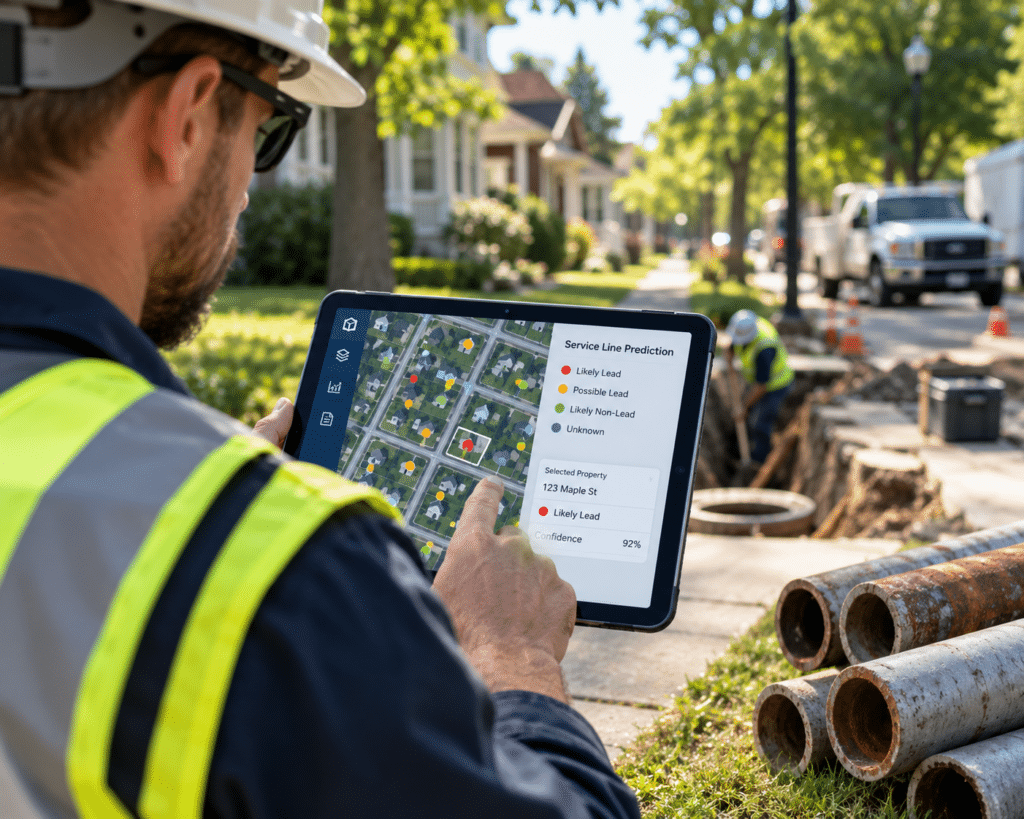
And for utilities managing both service lines and mains, there’s something even more compelling: the ability to dig once. Identify which street segments have the highest main risk and the most likely lead service lines, coordinate the work, and stop paying twice to break the same asphalt. The engine you buy for compliance becomes the engine that saves you money across your entire water distribution system.
But beyond the product, I’m genuinely curious to hear from the people in the field. What’s the real blocker? What does the decision actually look like from the inside? What would it take for your team to feel confident walking into a council meeting with a replacement list and standing behind it?
Those are the conversations that make a conference like this worth showing up for.
If you’re heading to D.C., find me at Booth 119. I’d rather spend thirty minutes hearing how your team actually makes replacement decisions than another thirty minutes at a panel talking about it in theory.
Book a private, 30-minute strategy session in advance, or stop by our booth in The Innovation Hub (Booth #119). We’d love to connect with you!